
South Africa
South Africa in ten photographs
September 24, 2026
South Africa was a week and a bit in January, moving roughly west to east: Cape Town first, then the coast road, then a few days of driving slowly and looking for animals, then Johannesburg at the end.
South Africa was a week and a bit in January, moving roughly west to east: Cape Town first, then the coast road, then a few days of driving slowly and looking for animals, then Johannesburg at the end.


Cape Town does the thing where a mountain sits in the middle of a working city. Table Mountain is flat on top because it is flat on top, and from the harbor it looks like a backdrop somebody painted. The path along the ridge gives you Lion's Head and about twenty-five miles of coast in one look.


We took the cable car up and hiked back down.


Then Boulders Beach at Simon's Town, which is a suburb with a penguin colony in it. Not a reserve an hour out of town — a beach, with a boardwalk, and a few thousand African penguins living on it. They walk right past your feet and are entirely unbothered by anyone.


The coast road east is the part people mean when they say Garden Route. Big dunes above the beach at Plettenberg Bay, and further along a concrete arch over a gorge deep enough that people pay money to jump off it.


Then inland and north, and the driving changes character: you go slowly, and you stop whenever something moves. A vervet monkey with a baby on her hip. A giraffe standing out in the open in the middle of the afternoon. A zebra and her foal, invisible in the grass until they weren't.
Soweto on the last day.
We stayed in an Airbnb — it wasn’t always the Ritz.
Soweto on the last day.
Nine years on, these are still the pictures I'd pull up if someone asked what South Africa was like. Which is the whole point of putting a code on a sticker: the photographs already exist, and the badge is the thing that makes anyone go and open them.
How it works
Scan the badge, load your gallery
Point a phone camera at the code on the badge. The photographs from that trip open straight away — no app, nothing to type, nothing to sign into.
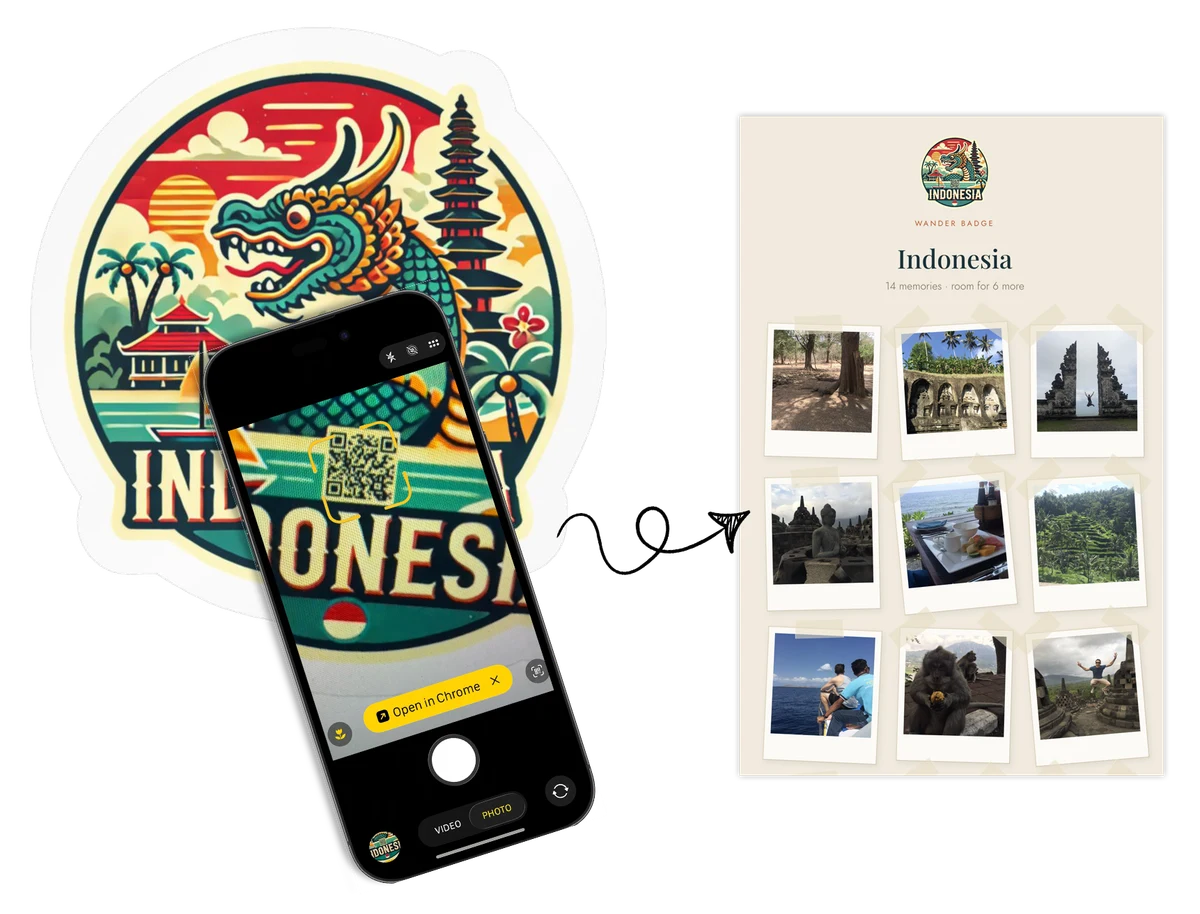
- Stick the badge on a case, a bottle, a laptop.
- Scan its code with any phone camera.
- Your photographs from that place open.