
Journal
The best scratch map alternatives in 2026
September 24, 2026
### The quick answer A scratch map is a satisfying way to mark where you’ve been.
The quick answer
A scratch map is a satisfying way to mark where you’ve been. It’s also easy to outgrow: once the novelty of scratching fades, the map tends to become décor that never changes.
If you’re looking for a scratch off map alternative, the best replacements all do the same core job in a better way: they make the record of travel more personal, more portable, and easier to keep updating.
This guide covers the best options in 2026 — from travel badges to journals to digital maps — with the tradeoffs that actually matter.
What people usually want when they buy a scratch map
Scratch maps are popular for good reasons. They’re:
- Instantly legible. One glance gives you the outline of your travel history.
- Ritual-driven. Scratching is fun. It feels like closing a loop — though it’s unforgiving: one slip of the coin and the mistake is permanent.
- Displayable. A map on a wall is a real object, not a file you forget.
But most people aren’t searching for an alternative because scratch maps are “bad.” They’re searching because one of these things happens:
- They’re out of wall space (or they move often and don’t want to frame/reframe a poster).
- They want something that travels with them — bottle, laptop, journal, suitcase.
- They want the map to mean something more than a colored country.
- They want the memories and photographs to stay attached to the place.
The real limitation of scratch maps
Scratch maps are good at recording that you went.
They’re not good at recording what it was like.
A country on a wall doesn’t tell you the story of the trip. It doesn’t surface the photographs. It doesn’t remind you of the moment you took them. And over time, that’s the part most people miss.
The best scratch off map alternatives in 2026
Below are the strongest alternatives, ordered by how well they replace the core scratch-map experience (a growing record of travel) while solving the portability and memory problem.
If you like the idea of collecting places — and you want the record to stay connected to your real memories — travel badges are the most direct upgrade.
A good badge system has three advantages over a scratch map:
- It’s portable. The collection lives on a bottle, laptop, journal, or suitcase.
- It’s durable. Moves don’t ruin it. You don’t need a single wall.
- It can connect to the photographs. That last piece is what a scratch map can’t do.
With Wander Badges, each place badge has its own QR code. When you scan it, it opens a private photo gallery for that trip — no app required. The badge is the reminder; the photos are the memory.
If you want the scratch-map feeling of “I’m building something,” but you’d rather build a collection you’ll actually keep adding to for years, this is the option that most closely matches that impulse.
One useful way to think about it: a scratch map is a wall summary. A badge collection is a set of specific places, each with a memory attached.
A journal sounds old-fashioned until you do it for one trip and realize what it gives you: the trip becomes legible again later.
If you want a scratch map alternative that’s cheap and flexible, try this:
- Keep a running list of countries (or regions) you’ve visited.
- For each trip, write five sentences: where you went, how long, who with, the best day, and the one thing you’d do again.
- Attach or link to a small set of photographs you’ll still care about.
The journal version of a scratch map is not the wall display — it’s the continuity. You can open a notebook from ten years ago and remember what mattered.
This option is best if you enjoy writing even a little, and you want the record to feel personal rather than decorative.
Digital travel maps get a bad reputation because most people make one, share it once, and never touch it again.
The better versions work when they do two things:
- They make it easy to add places as you go (not as a big project later).
- They give you a reason to return — by surfacing photographs, notes, or a timeline.
If you like the “one glance” benefit of a scratch map but you don’t want a poster, a digital map can be the cleanest substitute.
A good test: if it takes more than two minutes to add a place, you won’t keep doing it.
A scratch map is a compact record. A photo book is the opposite: it’s deliberate and slow.
If what you really want is not “I have been to 23 countries,” but “I want to remember what those years looked like,” a photo book wins.
The downside is obvious: it’s more expensive and it takes time. The upside is that it becomes one of the few physical objects you’ll keep.
This is a strong alternative if you take a lot of photographs and you want a tangible artifact that survives phone upgrades and cloud reorganizations.
Some people like scratch maps because the interaction feels like a game.
Sticker maps and stamp books keep that tactile element. They’re usually:
- easier to store than a poster
- more interactive than a plain list
- less fragile than a scratch layer
The tradeoff is that they still tend to be about the count rather than the memories, unless you pair them with photographs or notes.
How to choose the right alternative
The right scratch off map alternative depends on what part of the scratch map experience you’re trying to replace.
Pick travel badges if:
- you want something portable
- you like collecting physical items
- you want the memories and photos attached to each place
Pick a journal if:
- you want a personal record
- you like the idea of stories, not just a list
- you want a low-cost habit you can keep
Pick a digital map if:
- you care most about “one glance” overview
- you don’t want wall décor
- you want to see places on a map, not in a list
Pick a photo book if:
- you want an artifact that lasts
- you’re willing to spend time curating
- you care more about the photographs than the map
A quick note on price
Scratch maps are inexpensive, and it’s fine to like them for that.
But if you’re searching for an alternative, the decision is usually not “what is cheapest.” It’s “what will I still use in two years.” If you want something that keeps earning attention over time, paying a little more for a system you’ll actually maintain is usually the better trade.
Closing
The best scratch map alternatives all solve the same problem: the places are real, but the memories fade unless you make them easy to revisit.
A map on a wall can show the outline of your history. The better replacements help you keep the details — the photographs, the stories, the specific places — close enough that you’ll actually look at them again.
How it works
Scan the badge, load your gallery
Point a phone camera at the code on the badge. The photographs from that trip open straight away — no app, nothing to type, nothing to sign into.
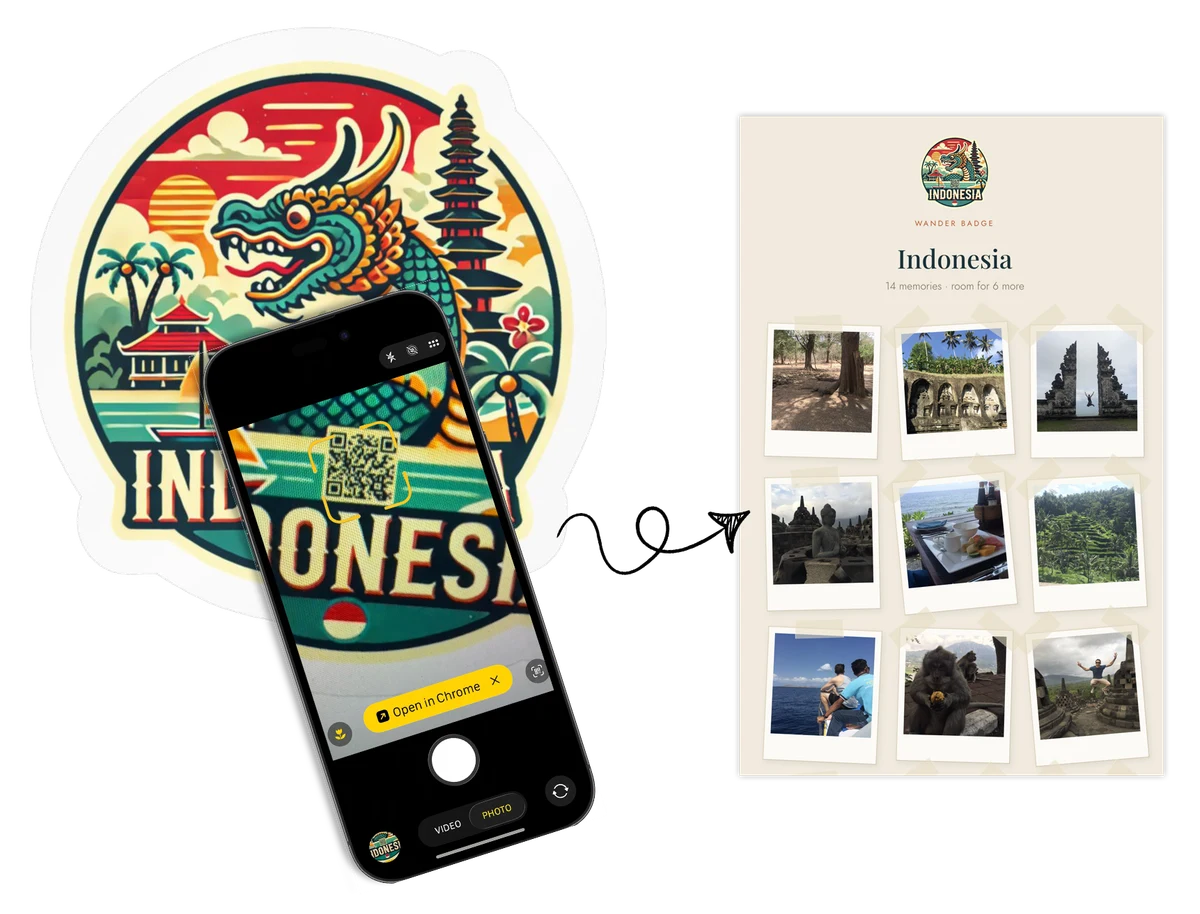
- Stick the badge on a case, a bottle, a laptop.
- Scan its code with any phone camera.
- Your photographs from that place open.